

Does it matter if you used a typewriter to mark down your text?
Does it matter if you used a camera to create your image?
The debate of technology’s impact on creativity and authenticity is ancient; to the point where typewriters became an art object and photography its own form. (BTW - the latest American Photographic Artists National awards just came out.) We slowly came to recognize these technologies as their own authentic means. We even came to prefer these technologies for specific artistic output over preceding methodologies.
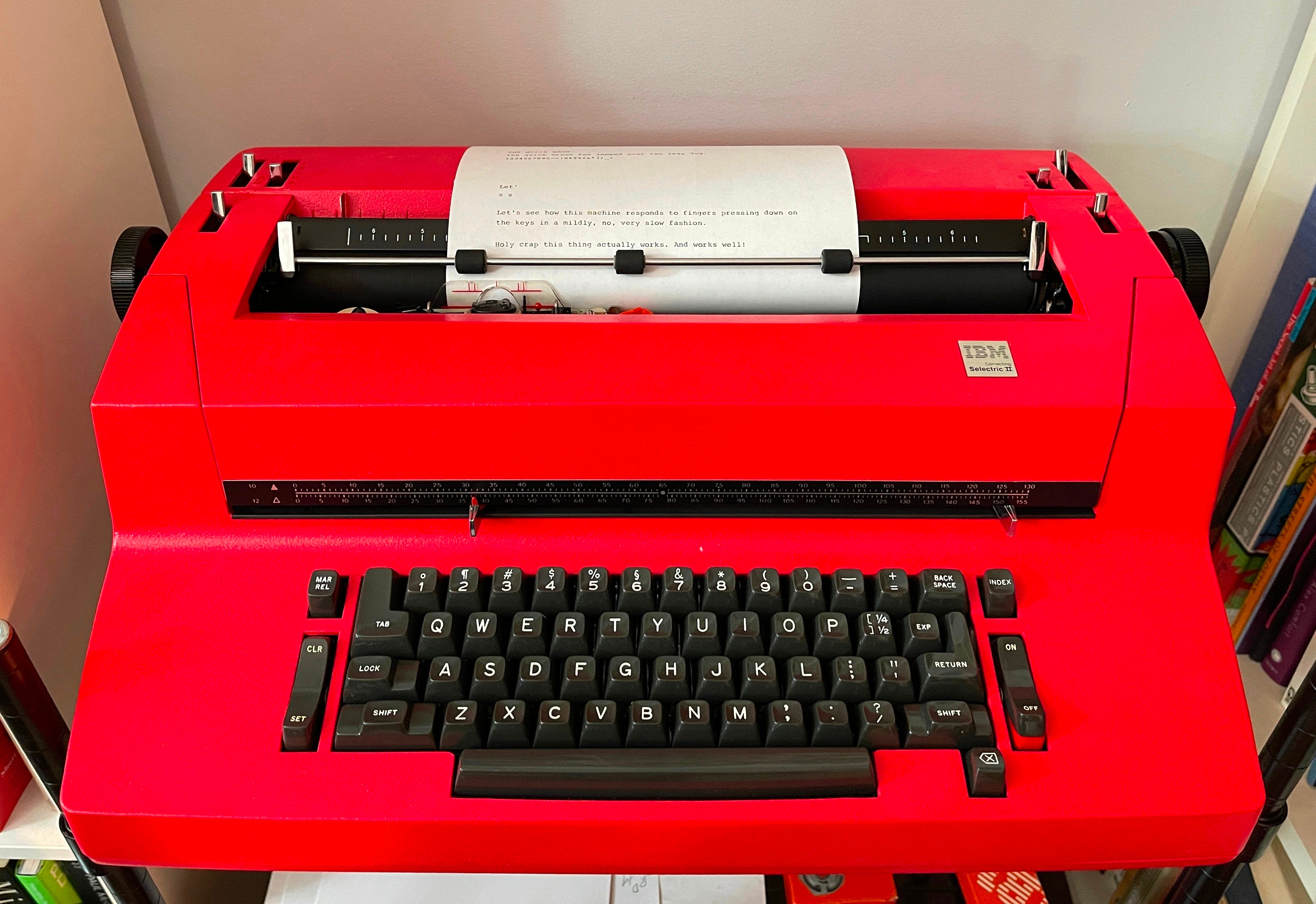
Perhaps most important: We can see the technology in action
I suspect this shift occurred in part because we could physically experience the tech. Like a pen applying ink to papyrus, a typewriter makes unique sounds, it generates an iconic output we can touch. Cameras are physical magic, converting moments into light trapped in chemicals and later pixels. These are technologies we can sense in more than one dimension. That’s part of what inevitably aided their transition from usurper and inauthentic to becoming distinct art forms and tools on their own.
Does it matter if you worked with an AI to arrange your thinking?
Finding ways to tag, code or watermark AI output have been around for a while now — invisible, digital content gets appended with a means of distinguishing it from, well, other digital content. And now Anthropic has announced it will watermark everything generated via Claude.
Claude Support: How Claude marks AI-generated content
“When a supported Claude model generates text, it weaves an imperceptible watermark directly into the text itself. You won’t see it, and it doesn’t change the meaning, quality, or readability of Claude’s response.”
“Watermarking will be applied at the model level, which means it will be present no matter which Claude product or surface the text comes from.”
So, of course, I asked my Claude what’s up. Because I use Claude all the time to hash out my thinking, to further research, to explore contrasts, to summarize complexity. And sometimes I don’t. Claude responded - bolding/italics mine:
“I can’t tell you with certainty whether any specific paragraph I gave you carries a watermark. I don’t have access to my own token-selection internals in a way that would let me confirm or deny per-output. What I can tell you is the mechanism exists, it’s rolling out, and your work may or may not be carrying an invisible fingerprint depending on model and timing.
But does it actually change what you do with the work? If the answer’s “I’d disclose AI assistance either way,” this is trivia. If the answer’s “I was counting on this being undetectable,” that’s the more interesting problem — and not one a watermark policy created, just one it exposed.”
I applaud Anthropic for developing its policy.
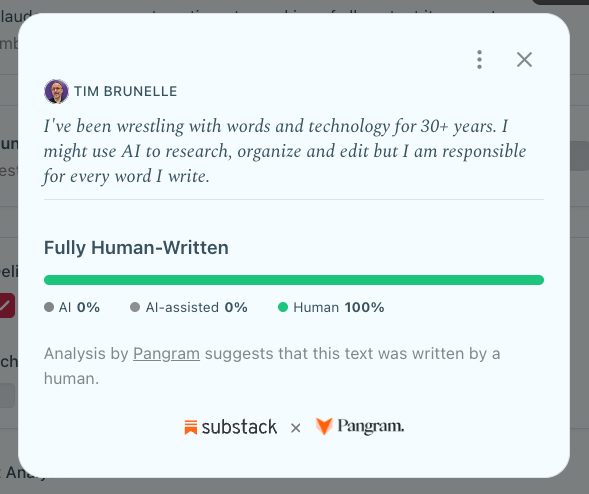
Substack has also rolled out its own AI-detection/attribution capabilities. Here’s Pangram’s analysis of this very post (and note my personal policy):
Are we more likely to adopt AI in the creative process if its role is easier to recognize?
I think that’s Anthropic’s bet.
To force recognition. To make provenance and maybe authenticity clear(er). To shift AI from output that’s indistinguishable from not using the technology to output we all know was made with the technology.
So the question facing us becomes: Does it matter? Will you stop using AI to enable, alter and enhance how you think, or how you create - if that use is undeniably known?
It’s too early to make bold claims. Part of me wonders if you read something that transformed you, or viewed something that wove its way into your soul - and later noticed it might have been written or influenced by AI, would you care? On the other hand, we might become overwhelmed discovering almost everything has “the touch of AI.” (And as Anthropic rightly points out, “Detecting a Claude mark tells you that the content may have been processed by Claude. It does not, on its own, confirm the full provenance of the content.”)
At the end of the day, what really matters is how the creation made you feel. And does it matter what journey any piece of creativity took to reach its final state? Well, that’s the debate we’ve been having for centuries - now continued and applied to AI.
My best wishes to all the agencies and marketers and their legal teams as they try to make sense of these new realities.
Anthropic did this, they say, to comply with EU regulations. My bet is that they really did it so they can demonstrate if other models, particularly Chinese ones, are distilling their frontier models to make their own versions. We’ll see.
In any case, because of the way watermarking works, we’ll see less and less serendipity in generated texts.
Its about trust, in the end. I read people (like you) because I trust your taste. If you make an argument, i'm more likely to be open to it because I know some of your experiences, I've read what you've written in the past and found it valuable. The more anyone's writing is influenced and, in some cases, written by an agent (it's not just a tool) with it's own ideas /weights, then the less I might be persuaded by you, Tim Brunelle. Use it for planning and research? Fine. Use it for the words you put your name next to, then I start losing respect and trust. (FWIW, i'm still working my thoughts out on this, and I've got a draft of a post comparing AI in a writers repetoire to a drum machine in a songwriters).