
224: Creativity, Inc.
I changed my mind: Ed Catmull's book is an enduring reference for understanding and leading creative effort

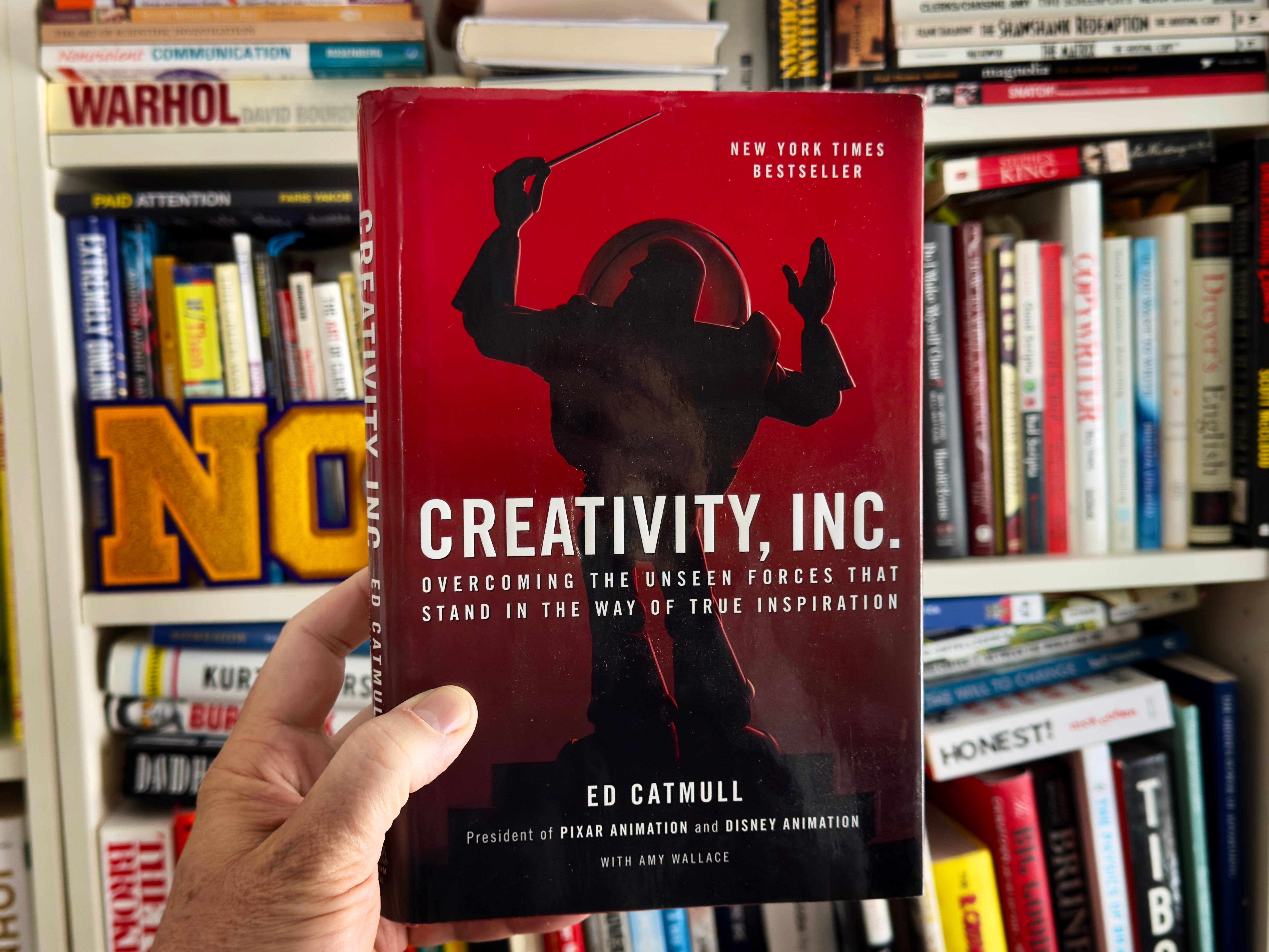
I first read Ed Catmull’s Creativity, Inc. - Overcoming the Unseen Forces That Stand in the Way of True Inspiration when it was originally published. And while I loved it then - I was irked by the notion of Pixar Animation’s peculiarity. I sensed their business model and practices were so distinct as to be inapplicable anywhere else. I was wrong.
“Craft is what we are expected to know; art is the unexpected use of our craft.” - Ed Catmull
There are many incredible books about the tactics, mindset and practice of the creative individual. Which is why Creativity, Inc. continues to stand out: running a creative operation of any type is glorious madness. Catmull helps demystify the necessary, confounding, and near magical architecture, politics and purpose of the creative enterprise. It’s one thing to nurture yourself, to survive amidst, and birth world-changing ideas. Quite another to conjure the same at scale, creating a reliable culture for thousands to deliver consistent economic value and global accolades. (And if your skeptical mind inserts, “wait, what about” - please jump to the Postlude below.)
I encountered this book at the tail end of running an agency I co-founded. I’m not sure it would have saved Hello Viking; but it might have given us a better shot. I’ve absolutely tried to leverage Catmull’s insights in other creative settings to varying degrees of success. One thing is certain: He’s writing about a team sport. Trying to implement his insights alone is likely a fools errand. But if you can align forces, Catmull offers cogent advice. I believe his boils down into two realms of thought.
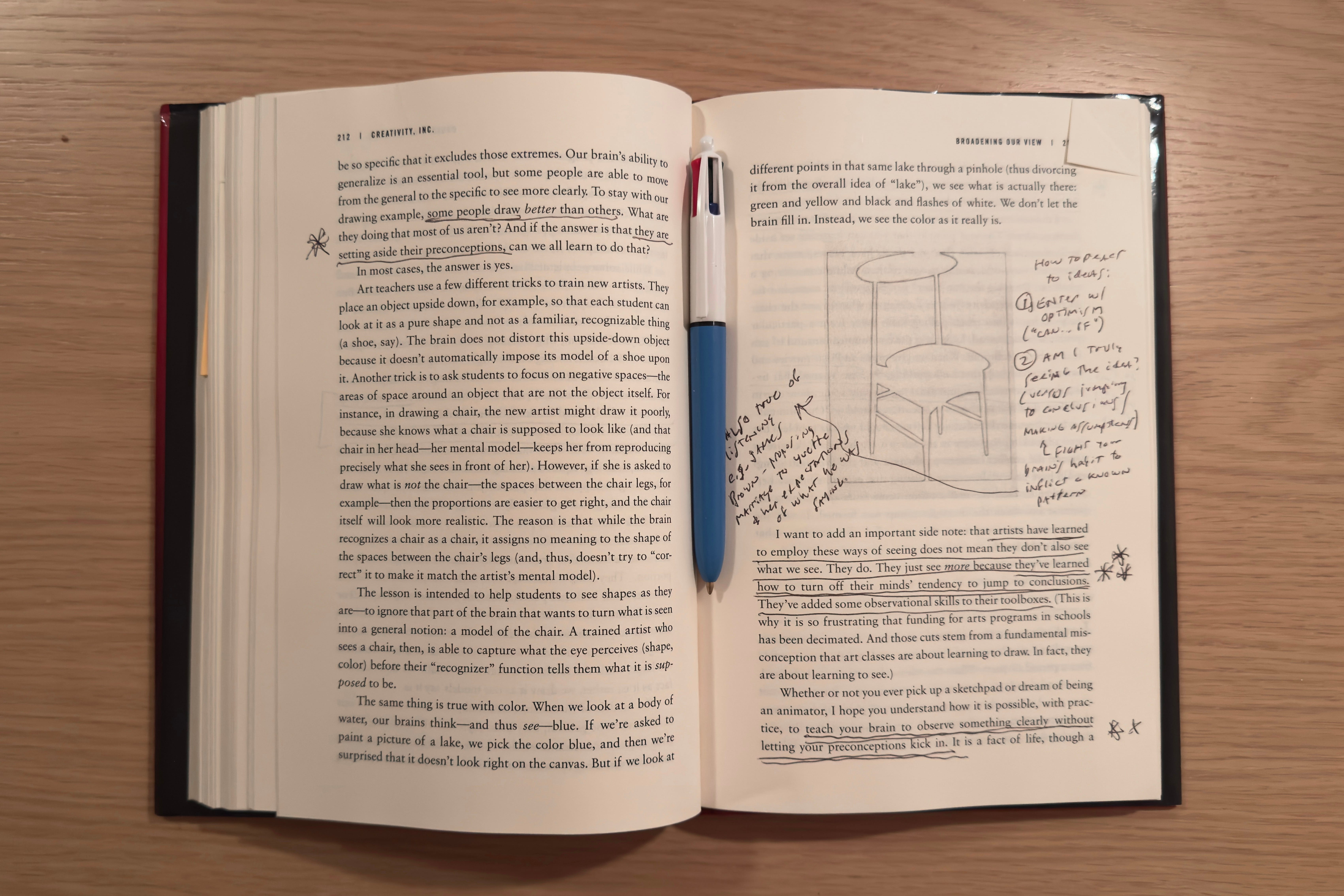
1. Creativity is predicated on failure
There are plenty who have believed and many who still harbor suspicions that creativity emerges best without friction. Those people are wrong, full stop. They simply are not seeing what is there. Or as Ed Catmull puts it,
“Originality is fragile. And, in it’s first moments, it’s often far from pretty.” “In order for greatness to emerge, there must be phases of not-so-greatness.”
Another way to think about this is to say brilliant ideas are most often unclear at first - flawless diamonds hidden inside lackluster volcanic rock. It takes a kind of seeing (which can be learned, taught and sustained) to elicit worthwhile results. The purpose of the creative enterprise is to allow for and fund the time, space, process, and culture - the seeing - which ultimately reveals brilliance. This sounds expensive. The alternative costs even more. Fear of failure, the anxiety surrounding not-yet-perfect, are unnecessary and unprofessional barriers on the path to worthwhile results.
“If you aren’t experiencing failure, then you are making a far worse mistake: You are being driven by the desire to avoid it.”
And this is where most enterprises collapse on the journey to leverage creativity, where emotions constrain optimism and possibility simply from a lack of patience; and the organization succumbs to both planning for and encouraging derivative work.
“If your primary goal is to have a fully worked out, set-in-stone plan, you are only upping your chances of being unoriginal… the desire to be safe—to succeed with minimal risk—can infect not just individuals but also entire companies.”
I suspect this mismanagement occurs out of inexperience. In the U.S. much of our formative education is built upon knowing things, on certainty. We rarely encourage sustained proximity to the beauty and fertility of failure. So you wind up with creative functions which are disabled on purpose; orchestrated to ship work which surprises no one with similar results. To run counter to this established routine takes courage.
Perhaps the most salient lesson Catmull offers is this:
“I believe the best managers acknowledge and make room for what they do not know—not just because humility is a virtue but because until one adopts that mindset, the most striking breakthroughs cannot occur. I believe that managers must loosen the controls, not tighten them. They must accept risk; they must trust the people they work with and strive to clear the path for them; and always, they must pay attention to and engage with anything that creates fear.”
Now imagine that’s your mandate, the guides by which your managerial performance will be measured.
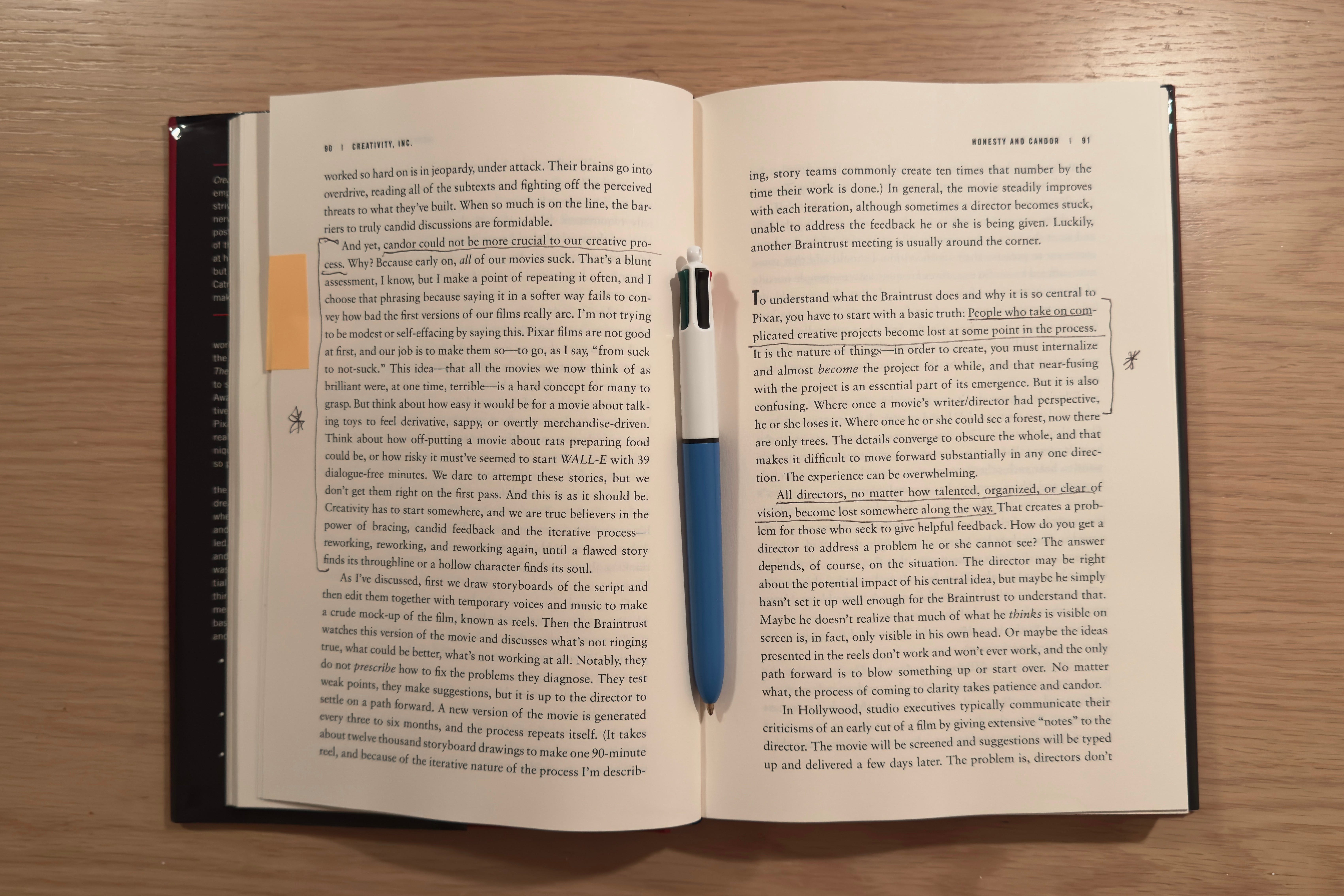
2. Which is why candor is absolutely necessary
I don’t know a single writer, art director, or designer who minds feedback on their output. Yet, one of the most (unnecessarily) nerve-wracking moments in the creative process surrounds this critical practice.
Now, let’s be clear: Creative feedback is a two way street. What we’re really talking about is attitude. And politics. And ego. And emotional economics. And everything that does not matter one whit but clouds the moment. Feedback is a loaded circumstance; if we allow it to be.
Candor is the solution.
If we’ve got the guts.
Candor requires an integrity and eagerness to empathize with one another that can seem off-putting. It requires an ability to be honest first with oneself, to admit your fears in productive and actionable ways. And then to hear not criticism but the gift of a path forward.
“That’s how much candor matters at Pixar: It overrides hierarchy… Candor isn’t cruel. It does not destroy. On the contrary, any successful feedback system is built on empathy, on the idea that we are all in this together, that we understand your pain because we’ve experienced it ourselves.”
Candor is weird because it feels at odds with the competitive, capitalistic systems we exist within. It’s a deliberate choice to feel a bit at odds and yet still make progress.
Postlude
Ed Catmull co-founded Pixar in 1986, later serving as president of Walt Disney and Pixar Animation Studios. Creativity, Inc. was published in 2014. In 2017, Pixar’s creative chief John Lasseter - who reported to Catmull - left amidst accusations of inappropriate behavior. Suddenly all that candor seemed a lot less true. Catmull retired from Disney and Pixar in 2018.
Catmull published an “expanded edition” of Creativity, Inc. in 2023, in part, to respond to those circumstances. But what’s perhaps more telling is the utter lack of acknowledgement of Pixar’s role in the High-Tech Employee Antitrust Litigation. Catmull preaches that “people are more important than ideas,” while the company’s 2005-2013 legal history suggests effort to limit those same people’s market value.
So, there’s the author with his circumstances and decisions. And then there’s the book and its ideas. I choose to delineate the two.
I think the book gives us solid frameworks, and insightful methodology to build and sustain all manner of creative enterprises so they can deliver remarkable outcomes. I think those are the roots which will continue to grow and thrive.